6 Series Convertible was unveiled in 2011 BMW 2011 North American International Auto Show. Early US model include 650i.[6] 640i was also available.[7]
السبت، 12 أكتوبر 2013
File:12-07-18-bmw-welt-klara-motte-01.jpg
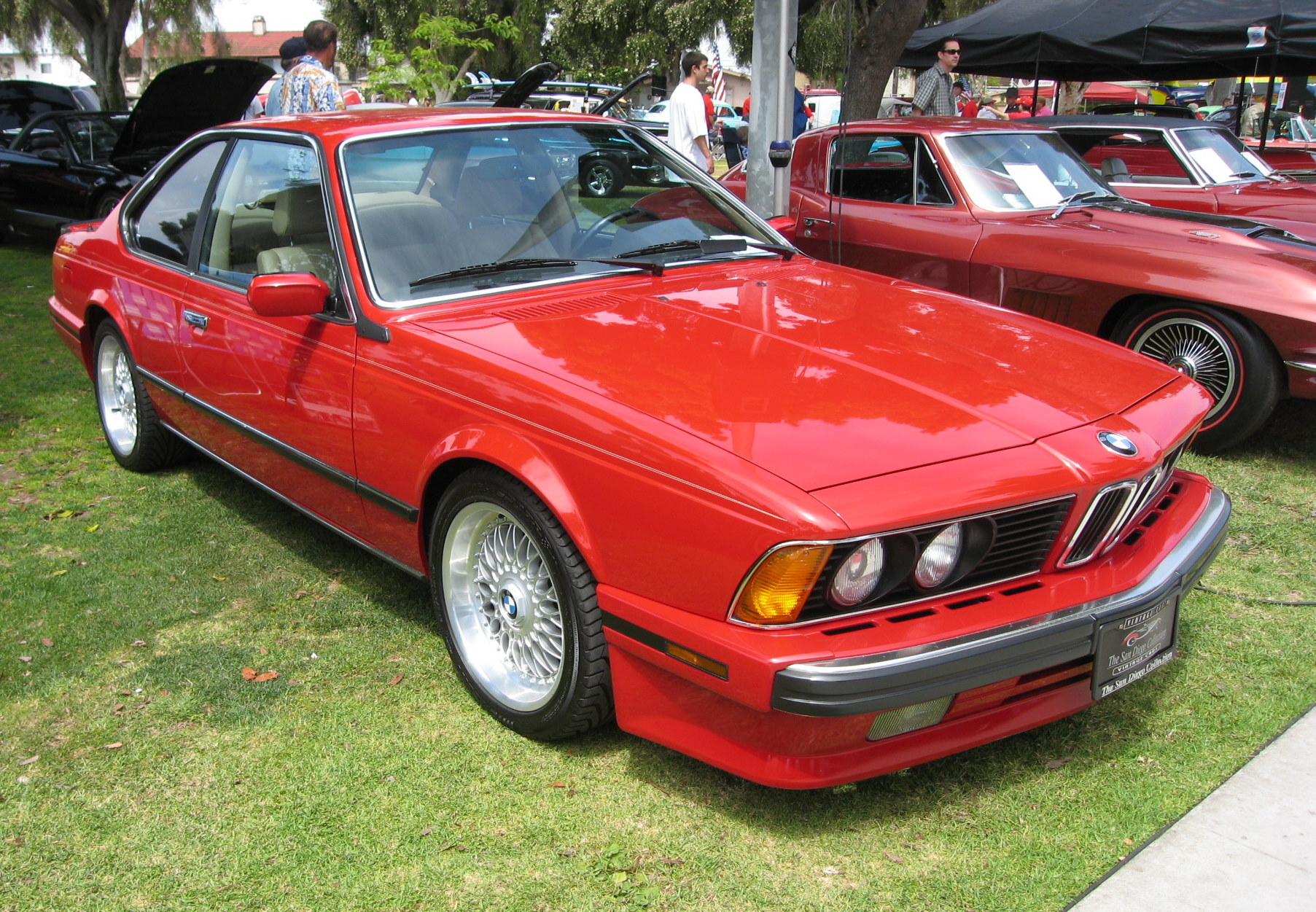
File:1986 BMW M6.jpg
In 1977, the 6er was released in the US as the 630CSi. This was a fuel-injected version of the carburetted 630CS available elsewhere. Its 3-litre engine developed 176 horsepower (131 kW) and 185 lbf·ft (251 N·m) of torque.
From model year 1983, North American and Japanese versions benefitted
BMW 6 Series (E24)
BMW 6 Series (E63)
The BMW E63/E64 is the second generation of the BMW 6 Series of luxurycoupés, introduced in Autumn 2003 in Frankfurt Motor Show by German car manufacturer BMW. It comes as either a coupé or cabriolet (convertible) and in several engine variants ranging from a 3 litre straight-6 to 5 litre V10 in the M6model. Production ended on July 8, 2010.
In 1989 the original 6 Series was supplanted by the more expensive and higher performance 8 Series. In late 2003, the 6 Series was reintroduced as a 2004 model as a coupé (E63) and cabriolet (E64) platforms. The E63/64 itself is based on the BMW E60, the latter which forms the fifth iteration of the 5 Series sedan.
The styling of the new 6 Series has generally received a warm welcome from the BMW community. The new 6 Series was designed to look like a shark, and many have acknowledged the resemblance. The controversial rear styling by Adrian van Hooydonk is considered to work somewhat better on the shapely E63 than on the E65 7 Series model which was controversial. However, most owners and enthusiasts of the E24 6 Series have disliked the E63.
Second generation
| Second generation | |
|---|---|
could reach 100 km/h (62 mph) in 7.4 seconds. The early cars were offered with a 5-speed 'dog-leg' Getrag gearbox. A four-
BMW R1200RT
Previous RT models, 1970s to 2005[edit]
BMW Motorrad began manufacturing "RT" (Reise-Tourer, or "travel tourer") touring motorcycle models in the late 1970s. The first of these were air-cooled (or "airhead") models that continued BMW's long tradition dating to 1923 of producing "boxer" or opposed flat-twin engined motorcycles with unit engine-transmission constructionand shaft final drive.
History
BMW was established as a business entity following a restructuring of the Rapp Motorenwerke aircraft manufacturing firm in 1917. After the end of World War I in 1918, BMW was forced to cease aircraft-engine production by the terms of the Versailles Armistice Treaty.[5] The company consequently shifted to motorcycle production in 1923, once the restrictions of the treaty started to be lifted,[6] followed by automobiles in 1928–29.[7][8][9]
The first car which BMW successfully produced and the car which launched BMW on the road to automobile production was the Dixi, it was based on the Austin 7 and licensed from the Austin Motor Company in Birmingham, England.
BMW's first significant aircraft engine was the BMW IIIa inline-six liquid-cooled engine of 1918, much preferred for its high-altitude performance.[10] With German rearmament in the 1930s, the company again began producing aircraft engines for the Luftwaffe. Among its successful World War II engine designs were the BMW 132 and BMW 801 air-cooled radial engines, and the pioneering BMW 003 axial-flow turbojet, which powered the tiny, 1944–1945–era jet-powered "emergency fighter", the Heinkel He 162 Spatz. The BMW 003 jet engine was tested in the A-1b version of the world's first jet fighter, the Messerschmitt Me 262, but BMW engines failed on takeoff, a major setback for the Emergency Fighter Programuntil successful testing with Junkers engines.[11][12] Towards the end of the Third Reich BMW developed some military aircraft projects for the Luftwaffe, the BMW Strahlbomber, theBMW Schnellbomber and the BMW Strahljäger, but none of them were built.[13][14]
By the year 1959, the automotive division of BMW was in financial difficulties and a shareholders meeting was held to decide whether to go into liquidation or find a way of carrying on. It was decided to carry on and to try to cash in on the current economy car boom enjoyed so successfully by some of Germany's ex-aircraft manufacturers such asMesserschmitt and Heinkel. The rights to manufacture the Italian Iso Isetta were bought; the tiny cars themselves were to be powered by a modified form of BMW's own motorcycle engine. This was moderately successful and helped the company get back on its feet. The controlling majority shareholder of the BMW Aktiengesellschaft since 1959 is the Quandt family, which owns about 46% of the stock. The rest is in public float.
BMW acquired the Hans Glas company based in Dingolfing, Germany, in 1966. It was reputed that the acquisition was mainly to gain access to Glas' development of the timing belt with an overhead camshaft in automotive applications.[15] Glas vehicles were briefly badged as BMW until the company was fully absorbed.
In 1992, BMW acquired a large stake in California based industrial design studioDesignworksUSA, which they fully acquired in 1995. In 1994, BMW bought the British Rover Group[16] (which at the time consisted of the Rover, Land Rover and MG brands as well as the rights to defunct brands including Austin and Morris), and owned it for six years. By 2000, Rover was incurring huge losses and BMW decided to sell the combine. The MG and Rover brands were sold to the Phoenix Consortium to form MG Rover, while Land Rover was taken over by Ford. BMW, meanwhile, retained the rights to build the new Mini, which was launched in 2001.
الاشتراك في:
التعليقات (Atom)